02.09.2026
Jacek Kwiatkowski
Brand or price? What drives tractor sales in times of austerity?
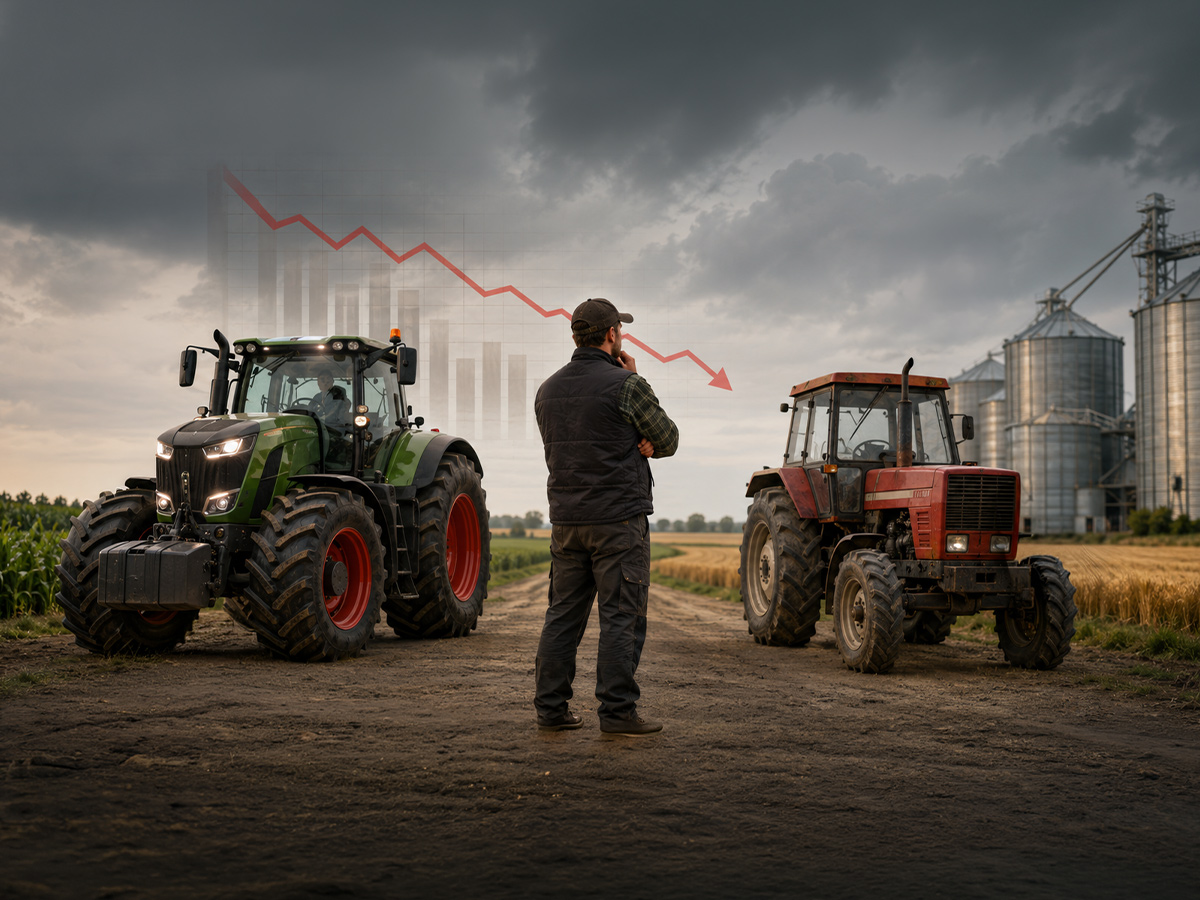
The market for new agricultural tractors is entering a period of marked slowdown. With year-over-year declines in new tractor sales reaching nearly 20% (AgriTrac data, comparing January–July 2025 to January–July 2026), manufacturers and importers must now grapple with a question that was not as pressing until recently: Under cost pressures, do farmers still prioritize brand above all else, or is price increasingly becoming the deciding factor?
The answer is not unambiguous. Research data shows that the decision to purchase a tractor is multidimensional today and increasingly rooted in the farm's economic calculus. The Polish countryside is undergoing an accelerated lesson economic survival – farmers are analyzing more and more precisely not only the purchase price, but also operating costs, service availability, resale value, and the predictability of machine use. As a result, the choice of a tractor today is determined not by a single parameter, but by the actual balance of costs and benefits.
Importantly, the decline is not evenly distributed. According to AgriTrac data, from January through July 2026, the number of tractor registrations in the 101–140 KM power range fell by nearly 42%, and in the 141–200 KM segment by 33%. At the same time, the number of registrations for tractors under 30 KM increased by 21%, and the average power of newly registered tractors fell from 118 KM to 114 KM. Not only is the market shrinking, but the structure of purchases is also changing
Cost pressure on farms – farmers count every penny
A good example of the changes taking place on farms is the ARiMR data concerning subsidies for elite or certified seed material under the de minimis aid formula. In the 2024 campaign, applications were submitted 65,138 applications, while in 2025 their number dropped to 43 270, or nearly 34%. After the application period ended in 2026, ARiMR announced that it had registered over 35k applications.
Table 1. Applications for subsidies for certified seed material under the de minimis scheme
| Campaign | Number of de minimis subsidy applications | Official source |
| 2024 | 65 138 | ARiMR, Report on the implementation of the ARiMR activity plan for 2024 |
| 2025 | 43 270 | ARiMR, Report on the activities of ARiMR for 2025 |
| 2026 | over 35 thousand. | ARiMR, Seed material 2026 – summary of the application process, 17.08.2026 |
Comparing these data, however, one must take into account the change in the support system. Starting from 2025, farmers can also use the eco-scheme „Elite category seed material or certified category seed material.” At the same time, ARiMR points out that in the same year, it is not possible to simultaneously receive de minimis aid for seed material and support under this eco-scheme. Therefore, the decrease in the number of applications for de minimis does not automatically mean a proportional decrease in the use of certified seed material.
The ARiMR data alone does not make it possible to determine to what extent the drop in the number of de minimis applications is due to farm savings and to what extent it is the result of choosing another form of support. However, this leads to a broader conclusion: when analyzing farmers' purchasing decisions today, it is not enough to look solely at the product price; the method of its financing and the final economic calculation are also gaining increasing importance.
This mechanism is particularly evident in investments of significantly higher value. If a farmer analyzes various financing and support options for expenses amounting to hundreds of zlotys per hectare, they will calculate the purchase of a tractor worth several hundred thousand zlotys in even greater detail. In such a situation, brand power still matters, but it must be weighed against price, financing cost, and the total cost of machine ownership.
Today, therefore, what matters is not only how much the machine costs, but how much it will cost the farm over its entire lifecycle.
Showdown in the marketplace: Giants versus „budget brands”
AgriTrac data shows that New Holland, John Deere, and Kubota – the big three of the Polish tractor market – are still maintaining their leading positions, accounting for a total of over 35% registrations. Their lead remains clear, but given the current cost pressures, it is becoming increasingly difficult to build that lead solely on the strength of the brand.
At the same time, manufacturers positioned in the lower price segments, including brands with Chinese, Korean, and Indian capital, are strengthening their position on the Polish market. A good example is Kioti, which, according to registration data after the first seven months of 2026, more than doubled its number of registrations compared to the same period in 2025.
Such high momentum must, of course, be analyzed in the context of a low base. This does not change the fact, however, that In a shrinking market, the growth of some manufacturers comes at the expense of the market share of others.. The farmer has a specific investment budget and is comparing not only the purchase price, but also the equipment, operating costs, service availability, residual value, and total cost of ownership of the machine with increasing accuracy.
The battle is therefore no longer just about who sells more tractors. Increasingly important is who best responds to the need to maximize investment value with a limited farm budget.
Is the brand able to leverage a higher price?
Yes, but under one key condition: it must deliver value that the farmer is willing to translate into a higher purchase price.
Research by Martin & Jacob shows that, apart from price factors, the choice of a tractor is primarily determined by parameters and features directly related to productivity and operational risk. More than 90% respondents cited power, nearly 55% cited low failure rates, and more than 40% cited quick access to service and replacement parts. These are the very elements that build the perceived value of the brand and make it possible to justify its positioning in the higher price segment.
The problem is that the value of a product and the ability to finance its purchase are two different things today. A farmer may prefer a proven premium brand because they associate it with reliability, service availability, and lower downtime risk, while at the same time lacking sufficient capital for the purchase amid high financing costs and pressure on farm margins.
This is where appears financing as an element of brand value strategy. Brand Premium brands do not necessarily have to lower their list price to increase the accessibility of their offerings. Instead, they can use factory financing, leasing, or manufacturer credit as tools to lower the barrier to entry and improve the accessibility of the investment.
As a result, competition is no longer played out solely at the level list price of the tractor, but at the level of the entire economic purchase model: installment amount, financing cost, operating costs, residual value, service availability, and projected total cost of ownership (TCO).
Today, a premium brand must therefore not only justify why it costs more. It must also make its purchase financially achievable for the farmer.
Table 2. Premium brand value versus investment barriers on the farm
| Decision criterion | Importance for the farmer | Significance for the premium brand |
| Tractor power | Over 90% results in the Martin & Jacob study | Argument for higher utility value and machine productivity |
| Low failure rate | Nearly 55% responses in the Martin & Jacob study | Reduction of downtime risk and the costs of unplanned repairs |
| Service and parts availability | Over 40% responses in the Martin & Jacob study | An element of dealer network advantage and operational safety |
| Brand reputation | It affects the perception of quality and reliability | It enables maintaining premium positioning |
| Purchase price | Key with a limited budget | It limits the ability to maintain a high price premium |
| Financing | It determines the availability of the investment | Maybe lower the barrier to entry without directly reducing the list price |
| TCO and residual value | They allow to assess the actual cost of use | They help justify the higher price with the total cost of ownership |
A premium brand can maintain a higher price if it can translate its technical, service, and operational advantage into real value for the farm. In current conditions, however, an equally important element of the offer is becoming accessible and tailored financing.
„Under current market conditions, a brand’s price premium cannot be based solely on its reputation. It must be reflected in performance parameters, reliability, the availability of service infrastructure, and the machine’s residual value. For a farm today, it is not CAPEX itself that is key, but rather the total cost of ownership and the operational risks associated with operating a tractor. At the same time, with limited financial liquidity, even an economically rational investment may be postponed. That is why manufacturer financing is becoming an increasingly important element of the competitiveness of premium offerings—it helps lower the barrier to entry without having to reduce the list price.”
— Jacek Skowroński, Management Board Member, Chief Technology Officer.
 „Under current market conditions, a brand’s price premium cannot be based solely on its reputation. It must be reflected in performance parameters, reliability, the availability of service infrastructure, and the machine’s residual value. For a farm today, it is not CAPEX itself that is key, but rather the total cost of ownership and the operational risks associated with operating a tractor. At the same time, with limited financial liquidity, even an economically rational investment may be postponed. That is why manufacturer financing is becoming an increasingly important element of the competitiveness of premium offerings—it helps lower the barrier to entry without having to reduce the list price.”
 Marketing proposal for the tractor industry
If a premium brand wants to effectively compete with the budget segment, its communication cannot be limited to exposing reliability, technology or design. Today, a key area of advantage is becoming lower barrier to entry for investment and making it easier for the farmer to make a purchasing decision right here and now.
This means the necessity of building an offer around financial instruments that limit pressure on farm liquidity and are tailored to seasonality and cash flow cycle in agriculture. Financing is no longer an add-on to the product – it is becoming an essential part of the brand's value proposition.
That is precisely the combination strong brand, predictable TCO and available financing can allow premium manufacturers to defend their price premium and limit customer attrition to cheaper alternatives offering a different price, equipment, and usage cost ratio.
„Today, a low machine price does not sell a tractor. A low barrier to entry does. Farmers increasingly evaluate an investment not by the list price itself, but by its impact on farm liquidity. Therefore, competitive advantage is determined today not only by CAPEX, but also by the financing structure, the installment amount, and the total cost of ownership. The manufacturer that can lower the barrier to entry without reducing product value gains a market advantage.”
— Marcin Chrobot, founder of the group and CEO of Martin & Jacob.
 „Today, a low machine price does not sell a tractor. A low barrier to entry does. Farmers increasingly evaluate an investment not by the list price itself, but by its impact on farm liquidity. Therefore, competitive advantage is determined today not only by CAPEX, but also by the financing structure, the installment amount, and the total cost of ownership. The manufacturer that can lower the barrier to entry without reducing product value gains a market advantage.”
 Precision marketing, which means the end of „one ad for everyone”
One of the biggest mistakes of modern agricultural marketing is the treatment of farmers as homogeneous target audience. With current margin pressure and limited household willingness to invest mass communication is losing its effectiveness, and a media budget without precise targeting can generate primarily costly reach instead of valuable leads.
A modern marketing strategy should be based on behavioral and contextual segmentation, taking into account, among others, the production profile, farm scale, investment potential, machinery park, and the stage of the purchasing journey. Also becoming crucial are purchase triggers – signals indicating that a given farm may currently be in the process of considering a specific investment.
In practice, this means moving away from the model „one ad – one message – all farmers” for the sake of communication dynamically tailored to the needs, potential, and decision-making moment of a specific recipient. This not only increases campaign effectiveness, but also allows for better utilization of the media budget and shortens the path from brand contact to a qualified sales lead.
What should modern, multi-channel communication look like?
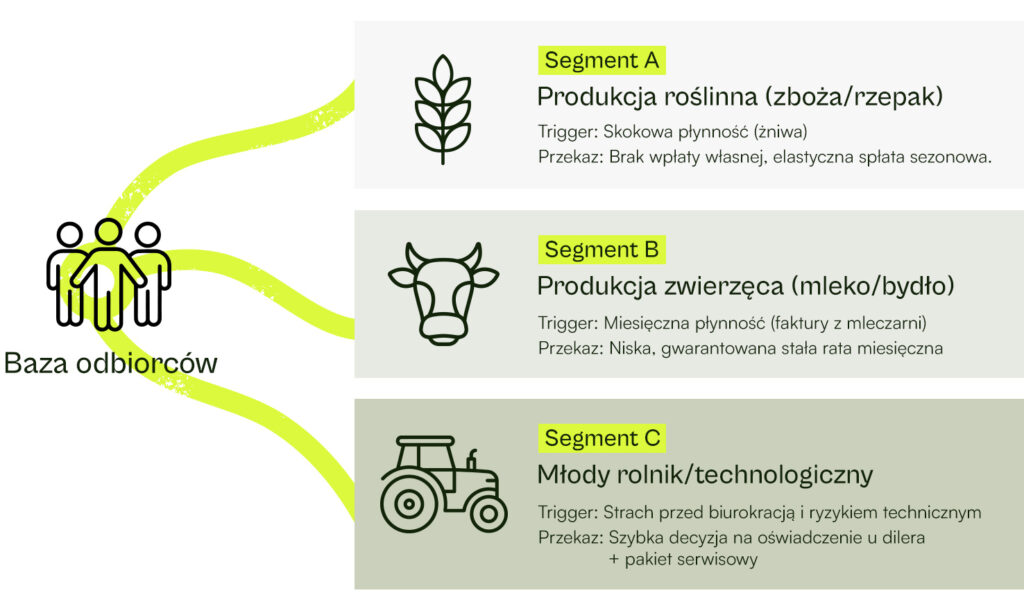
Modern marketing communication should not be designed according to one universal farmer profile, but around specific problems and purchasing barriers characteristic of individual household segments. An example approach could look as follows:
Table 3. Farm segmentation vs. differentiation of purchasing barriers and marketing messages
| Segment | Problem | Message |
| A. Cereal and rapeseed producer – step liquidity | Revenues appear primarily after the harvest. Off-season, the farmer cuts expenses and does not want to freeze capital in investments. | „Do not freeze your capital. Tailor the financing to your farm's revenue cycle and start repayment when revenues from crop sales appear.” |
| B. Milk producer – monthly liquidity | Regular income from milk production provides greater predictability, but the farmer is concerned about rising financing costs and market changes. | „Choose stability. A fixed and predictable installment allows you to plan the investment cost without worrying about increased burdens during the financing period.” |
| C. The farmer who bets on time | A reluctance to deal with complex procedures and banking bureaucracy, as well as the fear of machine downtime during a critical period of the season. | „Minimum formalities, maximum time for work. Quick decision at the dealer's and full service support when you really need it.” |
The above three segments may need the same product, but a completely different selling point. A grain producer needs a solution to revenue seasonality, a livestock farmer needs cost predictability, and a farmer who values time needs speed and convenience in the process.
That is the essence multichannel communicationwe are not changing the product, but we adjust the focus of the message to the actual purchasing barrier of a given segment.
FARM AI™ by Adagri – precision that turns theory into profit
The segmentation theory sounds good. The real challenge, however, is translating it into execution. This raises the question: how to reach different segments of farmers at the same time with a message that corresponds to their actual needs, buying barriers, and decision-making moment?
The answer is FARM AI™ – Adagri's proprietary solution that combines unique agricultural BIG DATA with the potential of artificial intelligence. The technology allows a shift from traditional targeting based on basic demographic data or declarations to behavior modeling and prediction of purchase decisions.
— Jacek Skowroński, Management Board Member, Chief Technology Officer.
The mentioned system analyzes real behaviors in 10 key decision dimensions, including, among others,. price sensitivity, risk aversion, or technology adoption. Thanks to this, the algorithm can identify not only that, who is recipient, but above all what can determine his purchasing decision.
In practice, this means moving away from the „one product – one message – entire target audience” model. For a dairy farmer, the key trigger might be the guarantee of a fixed installment and predictable financing costs, while for a rapeseed producer, an offer that reduces the need to commit capital before the harvest will hold greater value.
This is precisely the essence of precision marketing in agriculture – the algorithm identifies the most likely purchasing barriers and motivators, and then allows communication to be tailored to them. As a result, the dealer does not have to improvise with arguments. They receive a precisely defined sales context and a message that addresses the real need of a specific segment. Thus, data ceases to be merely an analytical resource and becomes a tool that directly supports the sales process.
Summary for agro brands
In the second half of 2026, the agricultural brands that will gain an advantage are those that move away from competition based solely on catalog price and they will start managing communication based on precise segmentation, real investment barriers, and the decision-making context of farms. Under conditions of margin pressure, limited liquidity, and growing investment caution, it is no longer enough to communicate „more for less.” You need to show a specific segment of farmers, why a given investment makes sense precisely in his economic and operational model.
Connection in-depth market data, behavioral analytics, and AI technology, such as Agro Decision Genome™, allows to move from mass reach to marketing precision – identifying the right audience, the right buying triggers, and the right arguments at a specific stage of the decision-making journey.
That's it data-driven marketing, precise targeting, and communication personalization mogą stać się jednym z kluczowych narzędzi odbudowy efektywności sprzedaży w trudnym otoczeniu rynkowym. Marki, które potrafią przełożyć dane o gospodarstwach na konkretne scenariusze komunikacji i sprzedaży, mają większą szansę lepiej wykorzystać istniejący popyt, defend sales targets, increase the efficiency of media budgets, and maintain a competitive advantage.
Return to all entriesMore inspiration
The farmer does not just buy the product. How to reduce purchasing risk in agro marketing?
 Read more
One brand, several worlds – why do a manufacturer, a distributor and a farmer see the same product differently?
Read moreThe Ministry is still debating the electronic record of spraying, and farmers are already sowing. Who thought of a field work calendar?
Read moreThe power of habit in farmers’ purchasing decisions – why do we choose what we know?
Read moreMarketing to farmers – 7 mistakes limiting campaign effectiveness
Read moreAI in agricultural marketing. How are farmers' decisions changing?
Read more



We have been connecting agro brands with farmers for over 20 years.
Talk to us about your campaign and start reaching the right audience.
Contact Us