27.05.2026
Jacek Kwiatkowski

Technical SEO for AI Search in Agriculture. What Does a Website Need to Succeed on Google, Discover, and AI Overviews?
Google no longer functions solely as a classic search engine where users type a query and choose from ten blue links. It increasingly resembles A response and recommendation generation system that combines various content formats — from organic results, through suggestions and graphics, to video, structured data, sources, and AI-based models. This is precisely why SEO for AI Search is becoming one of the key areas for building brand visibility in Google today.
For agricultural businesses, this change is more significant than it might seem. A farmer, dealer, distributor, or someone responsible for purchasing technology is no longer looking for a specific „website.” They are looking for answers, comparisons, arguments, prices, applications, risks, and recommendations.
Therefore technical SEO In the agricultural industry, it's no longer just about page speed, indexing, and correct headings.. They are still the foundation, but today we need to go further. The website must be built so that Google can understand it, the user can quickly make a decision, and AI systems have something to build an answer from.
This is the difference between classic positioning and preparing the website for SEO, GEO, and AI Search.
Google has been directing its search engine towards answers for years.
This change didn't start with AI Overview. For over a decade, Google has been building a search engine that understands not only words, but also meanings, relationships, and context..
2012 – Knowledge Graph and the transition from „strings” to „things”
In 2012, Google showed Knowledge Graph, describing the transition from „strings” to „things,” i.e., from mere character strings to understanding people, places, brands, products, and the relationships between them.
2019 – BERT and better natural language understanding
In 2019, entered the search engine BERT. Google explained at the time that the model helps to better understand language in rankings and featured snippets, and initially was intended to affect one in ten queries in the US in English. This was an important signal: the search engine was increasingly better at understanding questions phrased in natural language, not just keywords.
2021 – MUM and connecting information from multiple sources
In 2021, Google presented MOM, or Multitask Unified Model. According to Google, this model was 1000 times more powerful than BERT, trained in 75 languages, and designed to handle complex information tasks. This meant another step: the search engine was to become increasingly better at connecting information from different formats, languages, and contexts.
2025 – AI Overviews in Poland and the beginning of AI Search
In 2025 AI Overviews officially arrived in Poland. Google announced the expansion of this feature to European countries, including Poland, in Polish and English. From this moment on, discussions about SEO in Poland can no longer ignore AI Search.
These are not separate technological curiosities, but one line of development. Google increasingly wants to answer the user faster, more completely, and with fewer clicks.
Table 1. Google's Evolution from Link Search Engine to AI-Powered Answer System
| Rock | Change / Technology | Google transformation phase | Search engine optimization |
| 2012 | Knowledge Graph | The transition from „strings to things” – understanding entities (people, places, brands) and the relationships between them | The beginning of a search engine based on meaning, not just keywords |
| 2019 | BERT | Natural language understanding models in rankings and featured snippets (approx. 1/10 queries in the USA) | Better understanding of the context of entire sentences and user intent |
| 2021 | MUM (Multitask Unified Model) | Multilingual, multimodal (75 languages) model, significantly more advanced than BERT | Combining information from different languages and formats, better handling of complex queries |
| 2025 | AI Overviews (Poland and Europe) | Introducing AI-generated responses in search engines | Shift towards direct answers, fewer clicks on results |
| — | Overall trend | Gradual evolution from a link index to a response system | Google responds, instead of just linking to pages |
Why is this important for agro brands?
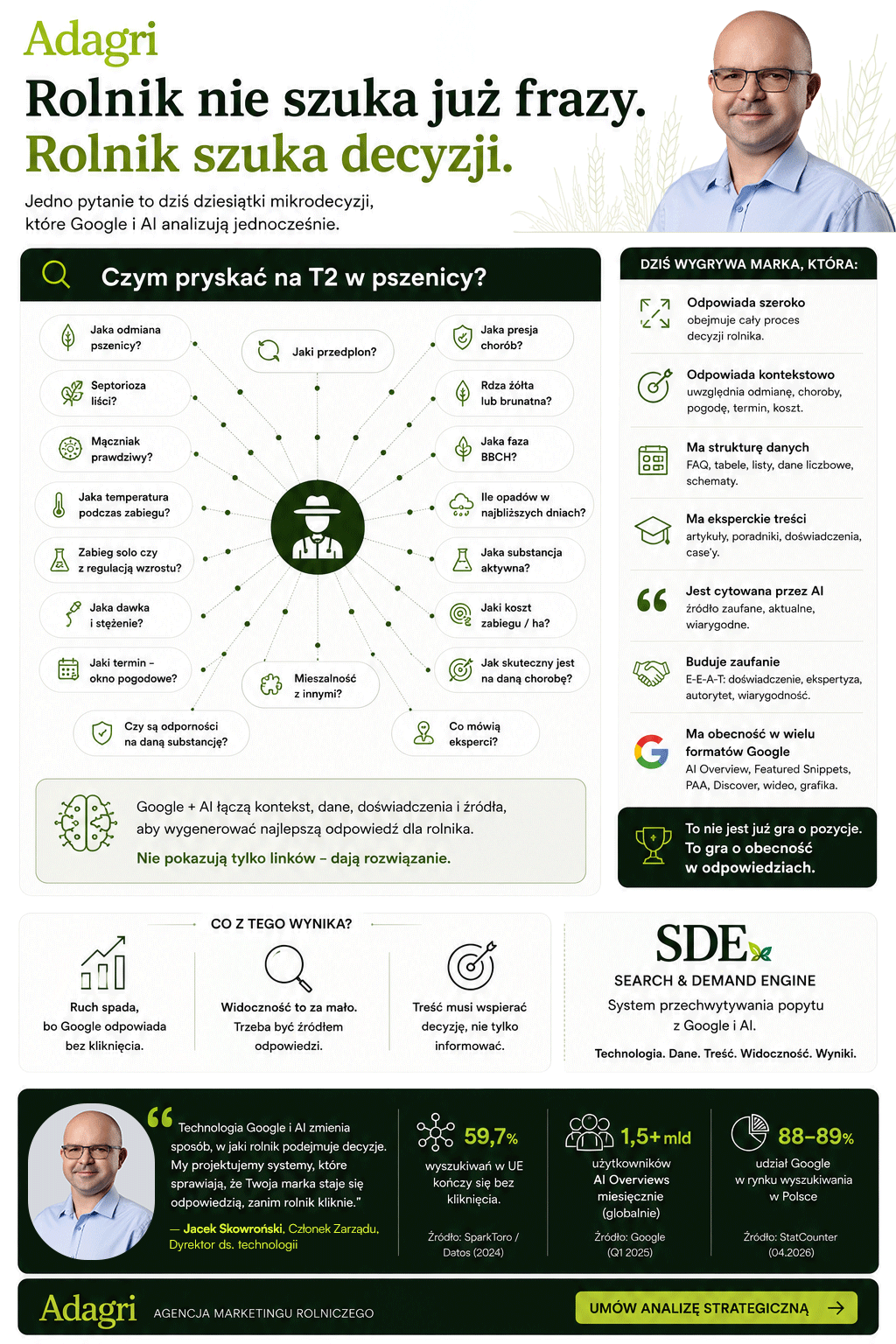
Because Google continues to serve as the dominant demand initiation point in the search ecosystem. According to StatCounter data from April 2026. This platform accounted for an 88.81% share of the search engine market in Poland, which confirms its strategic importance in generating traffic and capturing purchase intent.
At the same time Chrome had a 74.981% share of the Polish mobile browser market. As a result, this means that the way Google and Chrome display answers, content, and pages on mobile devices has a real impact on brand visibility.
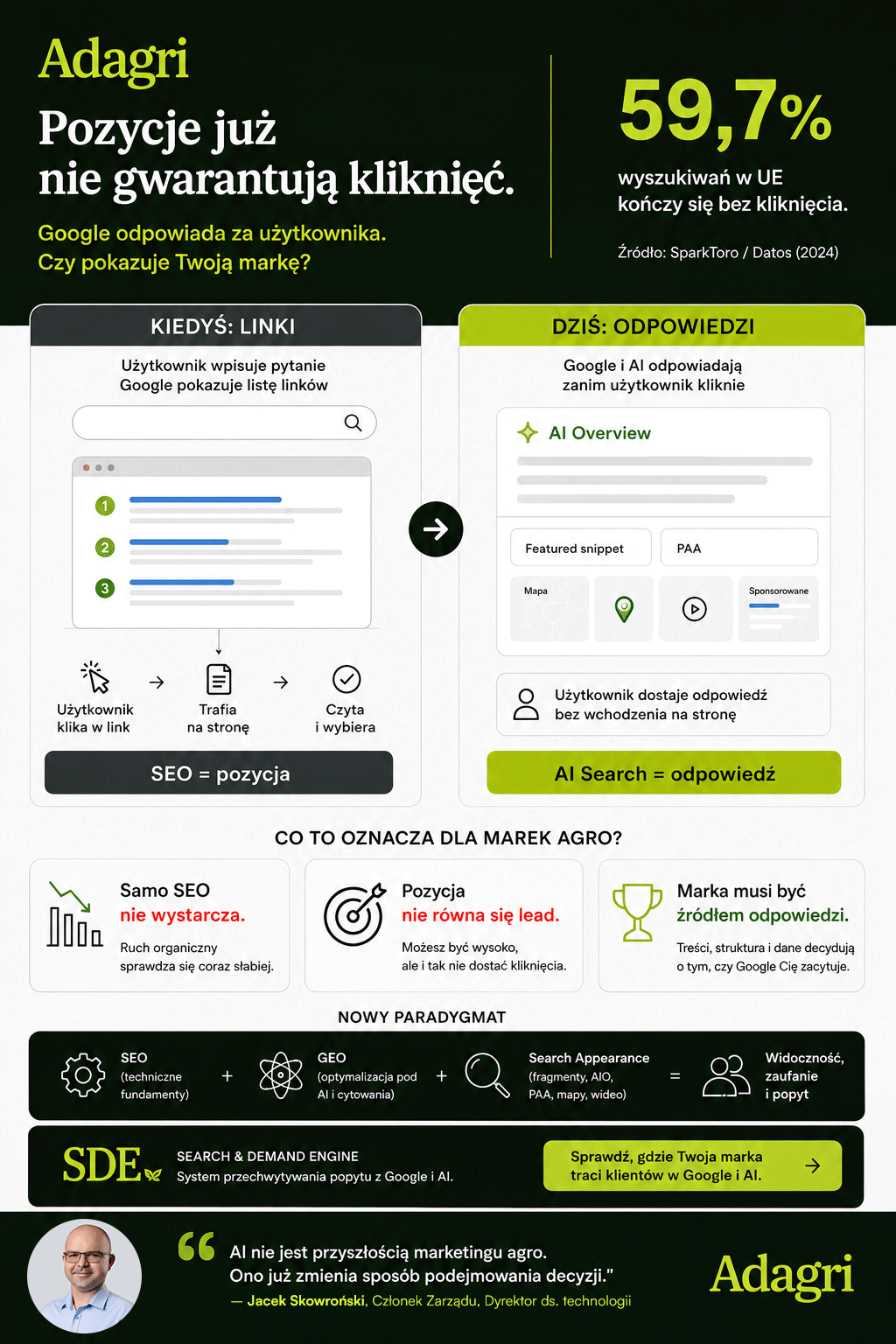
Furthermore, users are increasingly ending their searches without clicking. SparkToro and Datos reported in a zero-click study that 59.71% of Google searches in the European Union in 2024 ended without a click on an external website. However, this does not mean that SEO has stopped working, but rather indicates a change in its role. Simply being present on Google is no longer enough. It becomes important to simultaneously capture the user's attention, build trust, and effectively support them at the moment of decision-making.
For an agricultural company, this could mean a real difference between generating an inquiry and having no interaction at all on the contact form. The user might get an answer directly in the AI Overview module, review the generated content snippet and comparison, and then not proceed to a page that wasn't interpreted as a credible source of information. Alternatively, they might click on the result that best meets the criteria of precision, currency, technical depth, and a high level of subject matter authority.
Technical SEO is the foundation of AI Search
A greathttps://adagri.com/kontakt/#skontaktuj-siees of people think of SEO for AI Search as being solely about content. That’s a mistake. The content is of great importance, but if the website is slow, poorly rendered, chaotic, without structure, without data, without correct linking, and without clear information architecture, then even a very good article has a weaker starting position.
Google describes Core Web Vitals as a set of metrics that measure the real user experience: loading, interactivity, and visual stability of a page. For agricultural brands, this has practical significance. Users frequently search for information on their phones while at work, at home, in the field, and in between tasks. Therefore, if a page loads slowly, shifts its layout, or makes it difficult to click, they don't just lose their place. They lose their patience.
Technical SEO for AI Search should include at least several layers.
The first is Indexing and availability
Google must be able to see the page, understand its structure, and access key content. Blocks in robots.txt, incorrect canonicals, duplicates, orphaned pages, and unreadable menus can effectively limit visibility.
The second is performance
LCP, INP, and CLS are not just report embellishments. They are signals of whether a page is performing as the user expects. In an industry where decisions can be expensive and technical, a frustrating website experience can erode trust.
The third is structural data
Google emphasizes that structured data helps the search engine better understand content and qualify it for rich results. Google also provides business examples: Nestlé saw an 82% higher CTR for pages displayed as rich results compared to pages without such presentation, and Rakuten recorded 1.5 times longer time on pages with structured data. This isn’t a guarantee of results for every company, but it is strong evidence that how content is presented in search results matters.
The fourth layer is content architecture
An article about fertilization, a machine, a plant protection product, a precision agriculture system, or financing a purchase should not be a wall of text. It should have definitions, direct answers, problem sections, tables, data, sources, applications, limitations, and natural transitions to subsequent topics.
Table 2. Technical SEO Layers for AI Search
| Layer | Technical SEO Area | What does it consist of | Key elements / examples | Impact on AI Search and SEO |
| 1 | Indexing and Availability | Ensuring that search engines can find, read, and understand a page | robots.txt, canonical tags, duplicate elimination, orphan page elimination, clear menu structure and internal linking | Technical limitations may block content visibility in Google and AI systems |
| 2 | Performance | Page speed and stability from a user's perspective | Core Web Vitals: LCP, INP, CLS | It affects user experience, trust, and the quality of ranking signals; slow pages lower conversion rates. |
| 3 | Structural Dane | Facilitating search engine interpretation of content and context | schema.org, rich results, content markup (e.g., article, product, FAQ) | Better understanding of content by Google, higher chance of rich results, higher CTR |
| 4 | Content Architecture | How information is organized and presented on the website | Headings, definitions, problem sections, tables, data, sources, applications, limitations, thematic connections | It makes it easier for AI models to extract answers and increases the chance of content being used in generated responses. |
GEO does not replace, but requires better SEO
GEO, which stands for Generative Engine Optimization, ... is not an official Google term. It is an industry and academic term describing the optimization of content for visibility in responses generated by AI engines. In the paper „GEO: Generative Engine Optimization,” the authors indicated that appropriate measures can improve the visibility of pages in generative responses by up to 40% under the conditions studied.
In practice for agricultural brands GEO means that the content must be easy to use as a source for answers. It must respond specifically, have a logical structure, data, sources, context, and a clear distinction between fact, recommendation, and opinion.
It's not enough to write: „our product improves yield.”. However, it must be clarified:
- Under what conditions,
- in what crop,
- What problem?,
- by when,
- with what mechanism of action,
- based on what data.
AI doesn't need a slogan but well-organized knowledge.
„We've implemented AI where it genuinely increases efficiency: in data analysis, opportunity detection, and work organization. However, technology doesn't replace responsibility. In Search & Demand Engine, humans still decide on quality, relevance, and whether a recommendation has business value.”
— says Jacek Skowroński, board member, Chief Technology Officer.
 „We've implemented AI where it genuinely increases efficiency: in data analysis, opportunity detection, and work organization. However, technology doesn't replace responsibility. In Search & Demand Engine, humans still decide on quality, relevance, and whether a recommendation has business value.”
 This is very important because Google clearly communicates that its ranking systems are intended to promote helpful, reliable, and user-centric content, not content created solely to manipulate rankings. Google also warns that mass-generating content without user value may violate spam policies. Therefore, in agriculture, AI should accelerate analysis and organize work, but it should not remove humans from the quality control process.
Discover is not classic SEO
Google Discover is a separate element. In traditional SEO, the user enters a query. In Discover, content can appear to the user because it matches their interests. Google describes Discover as a feed of content related to the user's interests, pulled from Google's indexed resources.
An article in Google Discover doesn't need to match a single specific search phrase. Therefore, it's crucial for it to be engaging, current, and easy to understand, as well as appropriately illustrated. Equally important is its connection to topics that actually interest users – so that the content can appear in their personalized recommendations and naturally fit into their current interests.
For the agro industry, this is a huge opportunity, but only if the content is dynamic: seasonal, specific, practical, expert, and grounded in market realities.
Discover lubrication. SEO likes intent. GEO likes structured responses. AI Search likes sources, data, and clarity. A good strategy doesn't pick one of these areas. It combines them into a system.
What should an SEO, GEO, and AI Search-ready agricultural company website have?
Modern SEO and the Search & Demand Engine approach are no longer based on a single element, such as just ranking in Google. It's a system of several interdependent layers: technical, content, trust, information architecture, and performance measurement. Only their combination determines brand visibility and real impact on user decisions.
First, the technical foundation
Indexing, speed, Core Web Vitals, mobile, structured data, clear information architecture, and logical internal linking.
Secondly, content that answers real questions
Not only „what it is,” but also „when to use,” „for whom,” „how much it costs,” „how to compare,” „what are the limitations,” „what are the mistakes,” and „what to choose in a specific case.”.
Third, the trust layer
Author, expert, sources, update date, citations, data, experience, and accountability. In the agricultural industry, this is particularly important because decisions often concern money, season, yield, equipment, and risk.
Fourth, the structure of sub-answers.
Brief definitions, „in a nutshell” sections, tables, comparisons, checklists, and concrete examples. These help the user, but also make it easier for machines to understand the content.
Fifth, measurement
Without data, it's unclear whether the problem lies in position, CTR, technique, intent, lack of CTA, or poor content. Therefore, the Search & Demand Engine doesn't end with an audit. The audit must transition into tasks, and tasks into execution. The table below organizes these elements into a coherent operating model.
Table 3. Search & Demand Engine Pillars
| Area | What does it include? | Why is he/she doing that? | Effect for visibility and business |
| 1. Technical foundation | Indexing, Core Web Vitals, page speed, mobile-first, structured data, information architecture, internal linking | Allows Google to correctly read and evaluate the page | The website is visible, fast, and „understandable” for search engines. |
| 2. Content answering the questions | „What is it”, „how does it work”, „when to use”, „for whom”, „how much does it cost”, „how to compare”, „what are the mistakes”, „what to choose” | It covers users' real intentions, not just keywords | Increased traffic from various decision stages |
| 3. Trust Layer (E-E-A-T) | Authorship, Expertise, Sources, Last Updated Date, Data, Experience, Accountability | Builds content credibility in the eyes of the user and the algorithm | Higher CTR, better conversion, and increased resilience to competition |
| 4. Structure under the answer | Definitions, „brief overview” sections, tables, comparisons, checklists, examples | Facilitates quick understanding of content by users and AI | Higher chance of featured snippets and AI Overviews |
| 5. Measurement and Iteration | Data (CTR, rankings, traffic), intent analysis, CTA, problem diagnosis, audit → tasks → implementation | Allows you to understand what's working and what needs improvement. | Continuous scaling of effects instead of one-time optimization |
Effective presence on Google today, therefore, does not result from a single factor, but from an entire system. The technical foundation enables indexing, content answers questions, the trust layer builds credibility, structure facilitates content interpretation, and measurement closes the loop with continuous optimization.
— adds Jacek Skowroński.
Modern SEO in agriculture is a system, not a single tactic
If someone today says that SEO in the agro industry relies only on keywords and links, they are describing a world that no longer exists. Keywords and links are still important. However, alongside them are AI Overviews, Discover, Search Appearance, Core Web Vitals, structured data, helpful content, zero-click search, and GEO.
Farming companies don't need to panic. They need to build a system. One that regularly checks data, detects lost clicks, improves technique, updates content, builds authority, and creates content that can be useful for both humans and AI systems. The future of search isn't about SEO disappearing, but about it becoming more technical, more expert, and more human at the same time.
That's exactly why the tool was created at Adagri Search & Demand Engine. Thanks to it, brands operating in the agro-industry that will benefit from it will not lose demand where decisions are made today – in Google, Discover, and AI answers.
| Remember! SEO in the agricultural industry is not just „Google visibility.” Today, it's a system that must operate simultaneously in:
|
Read also:
Knowledge Architecture in Agriculture: How AI Systems Are Changing the Model of Agricultural Advisory Services
AI positioning in agriculture - how to build sales when website traffic is declining?
More inspiration
Sustainable agriculture as a source of competitive advantage in agribusiness
 Read more
Why Invest in Collaboration with Agricultural Industry Experts in Marketing?
Read moreRemarketing campaigns in the agricultural industry – how to effectively remind farmers about yourself?
Read moreKnowledge Architecture in Agriculture: How AI Systems Are Changing the Agrotechnical Consulting Model
Read moreBrand positioning in agribusiness. How to find a Unique Value Proposition (UVP) and break free from price wars?
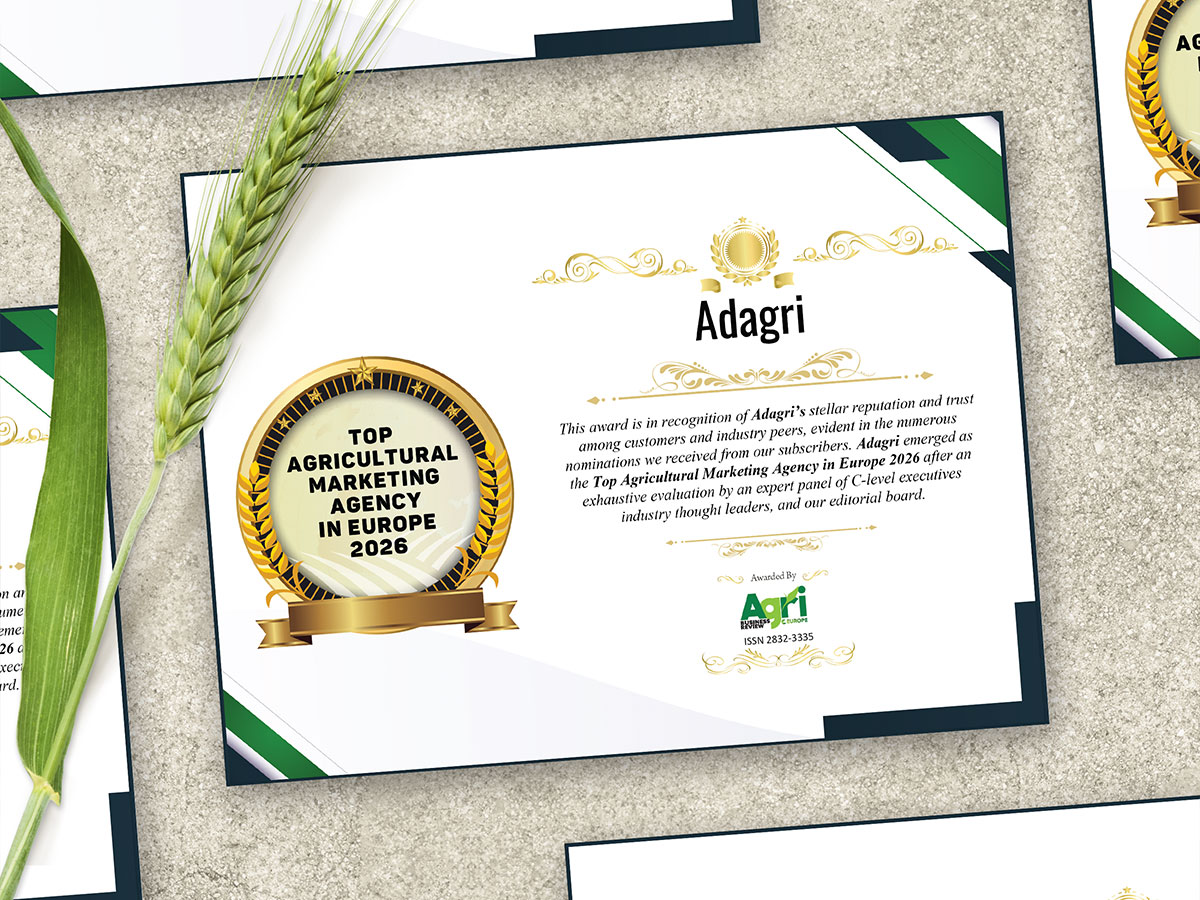
Read moreAdagri with the prestigious title „Top Agricultural Marketing Agency in Europe 2026” – a new era of precision communication
Read more





We have been connecting agro brands with farmers for over 20 years.
Talk to us about your campaign and start reaching the right audience.
Contact Us